
HOW TO IDENTIFY THEM
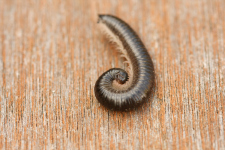
Portuguese millipedes (Ommatoiulus moreletii) have a smooth, cylindrical body made up of lots of tiny segments and range from grey to black in colour. They are between 2.5cm and 4cm long and are long and straight when they are walking but often curl up in a spiral when they are hiding or in danger. The term ‘millipede’ means a thousand (milli) feet (pede) but in fact, they generally have legs that only number in the hundreds but still, that is still an awful lot.
Portuguese millipedes begin mating in autumn and then over the next two months the females lay about 200 pinhead sized eggs in a hole in the soil. After about a week, the eggs hatch but the tiny millipedes can’t walk because they don’t have legs but then they start to grow, moulting up to eleven times over the next two years and developing the hundreds of legs that they have as adults.
THE DAMAGE THEY CAUSE
Portuguese millipedes were accidentally introduced to Australia and have now become pests. Although native millipedes play a useful role in breaking down organic matter in the soil, Portuguese millipedes are a problem when they reach really high numbers which is when they can occasionally damage crops such as melons, strawberries, tomatoes and potatoes.
They are not harmful to animals or humans but can invade homes in their hundreds in autumn and spring as they are attracted by the house lights at night. They do not breed inside houses and once inside will probably die. To the home gardener, they tend to be more of a nuisance than anything although in 2002, there were so many on the tracks between Melbourne and Ballarat that 50 trains couldn’t run because their wheels kept slipping. The Portuguese millipedes had to be cleaned off before the trains could run again!
HOW TO CONTROL THEM
Unfortunately, Portuguese millipedes don’t have any natural predators so since they were introduced to Australia in the 1950’s, their numbers have grown to plague proportions in many parts of Australia.
Portuguese millipedes are attracted by the house lights at night so to stop them from coming in, turn off all outside lights and close the curtains and blinds at night so that they can’t see the indoor lights either. Effective door seals will prevent them from getting in underneath and clean up compost, mulch and leaf litter from close to the house as this will be where they are living.
If Portuguese millipede numbers are really bad, smooth barriers around the house will stop them from getting a foothold. These can be made with smooth vinyl, thick polythene tape, teflon-coated tape or even slippery pipe. Place long strips under the windows and doors but they can still get around them if they really want to.
Light-traps can be useful also and are quite easy to build with mum or dad’s help. Cut a piece of storm water pipe so that it is about 40cm long and bury it vertically so that the top is flush with the ground. Set up a solar light so that the light itself is in the bottom of the pipe. The light will attract the millipedes at night which will fall in and not be able to escape.