
Here’s a question for all the mums and dads (and the teachers). Put up your hand if you’ve ever used a humidifier to improve the air quality in your kid’s bedroom or bought one of those fandangled vacuum cleaners with the special filter that cleans the air. And whilst you’re at it, have you ever wanted your kids to calm down a little and to stop making such a racket in their bedroom? You might have even told them that they should concentrate more when they are doing their homework.
What if I told you that I might have something that could help with these problems and more? I bet you don’t believe me.
Ok, so indoor plants won’t solve all your parenting problems but they might help more than you think. Indoor plants improve air quality, lower stress levels, make kids feel more positive and concentrate better and they help to reduce noise. That’s a pretty good start.
Indoor plants have been used in offices for years for these very same reasons. Employers have long known of their benefits which are just as effective on children as they are on adults. So, it stands to reason that kids’ bedrooms, activity rooms and even classrooms should have at least a couple of indoor plants so that they can work their magic.
Studies have shown that indoor air is almost always more polluted than outdoor air because our modern day homes are full of carpet, fabric, furniture and even toys that are all made from plastic and synthetic materials which release ‘volatile organic compounds’ (VOC’s) such as benzene, xylene, ammonia and formaldehyde. These cause headaches, lack of concentration and eye, nose and throat problems. Of course, we also breathe out carbon dioxide in our homes which adds to the problem, making us drowsy and a bit vague.
The leaves, roots and the potting mix on indoor plants are very effective at removing urban air pollution as well as VOC’s and they also put oxygen back into the room. In fact, a NASA study found that common house plants could remove up to 87% of air toxins in 24 hours.
Indoor plants also help to absorb noise (though you may need a forest of them to silence a herd of raucous kids) and they make people feel happy and calm. It’s the same feeling of relaxation that we get when we sit and look at the garden outside the window.
Choose hardy indoor plants with the beautiful glossy leaves such as ficus, philodendrons, spider plants, peace lilies and ferns. All of these will cope well with the reduced light of a bedroom and are very effective air purifiers. They are easy to care for and are available at all garden centres.
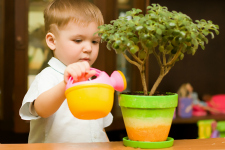
Of course, the plants should be the kids’ responsibility if they are old enough to take this on. They can give them a name, perhaps even put sunglasses on them and decorate their pot. They can even be taught how to care for them as well including how to give them a sponge bath every month or so. Our Caring for Potted Plants fact sheet will help you teach them how.
Be a little bit careful with younger children though who haven’t yet learnt that not all plants are edible. Some indoor plants can be toxic if they are ingested but are perfectly safe if they are kept up high where toddlers can’t get to them.
Happy indoor gardening!