
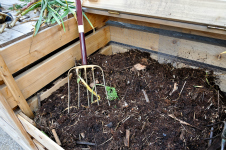
Compost is a mixture of decaying organic matter such as leaves, manure and kitchen scraps which, once it has broken down, is used to improve the soil in the garden. It is rich in nutrients and when it is mixed through the garden bed it provides food for the plants, encourages worms into the garden and helps the soil hold water for the plants to use.
Mother Nature makes compost all the time. If you go to the park or into the bush, you will see that all the leaves, pieces of bark and dead plants have rotted down into a dark, rich layer over the surface of the ground. If you dig down a little bit, there will be little insects scurrying around and perhaps even a few worms and the soil will be full of nutrients for the plants and trees around to feed on.
You can make compost at home as well and you can probably do it even quicker than Mother Nature can by building a compost heap!
THE COMPOST HEAP
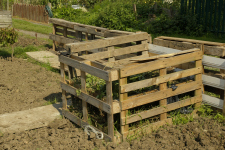 A compost heap works really well for gardeners with lots of material to compost. This can just be a massive pile of compost but it is much better to build a large timber cube which is about 1metre in height, width and depth. An easy way to build these is to find four old pallets from a transport company and use these to build the outer walls. There doesn’t need to be a floor and all that is needed on the top is a piece of canvas.
Alternatively, chicken wire can be rolled into a cylinder which is about 1metre high and 80cm across. When this is stood on the ground, it is a really effective way to hold the compost in place.
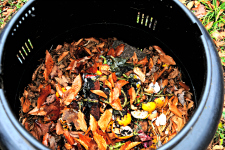 Plastic compost bins can be purchased at a hardware store and they are great for small gardens as they keep the area tidy and, because they have a lid, they help to stop flies from hanging around. Some gardeners have two or three bins working at the same time.
WHAT CAN GO INTO THE COMPOST?
Everything that goes into the compost must be organic such as leaves, grass clippings and kitchen waste. If it was once growing in the ground, it can probably go into the compost. It is estimated that almost half of the waste from an average household can be added to the compost bin. Below is a list of things that can be put into the compost and they are divided into two groups:
Green Ingredients:
- Grass clippings
- Vegetable scraps from the kitchen
- Cow or sheep manure (because they eat grass and vegetable matter)
- Green leaves and old flowers
Brown Ingredients:
- Shredded paper
- Straw or hay
- Dry leaves from the garden
- Egg shells
- Coffee grounds, tea leaves and tea bags.
- Sawdust
- Old potting mix
- Vacuum cleaner dust
- Wood ash
WHAT CAN’T GO INTO THE COMPOST
Some things must never go into the compost because they attract flies and rats and will not benefit the garden. Here are some things not to put in the compost:
- Any meat products.
- Any dairy products.
- Dog or cat manure because they eat meat.
- Whole eggs
- Branches with thorns on them as they don’t break down very well.
- Weeds with seeds on them as they might germinate in the garden.
- Diseased plants as the disease might spread through the garden.
- Shiny paper such as from magazines.
MAKING THE COMPOST
Building the compost heap is a lot like making a salad sandwich, you need to make it in layers. Start with a layer of brown ingredients such as dry leaves, straw and shredded newspaper then put a layer of green ingredients such as lawn clippings. Keep alternating the layers until it is about 1metre high or the bin is full. If you don’t have quite enough ingredients, that’s ok as you can keep adding more onto the top but it does have to be fairly high so that it will heat up enough to encourage the aerobic bacteria in the soil get busy and start breaking everything down.
Close the lid on the bin or put a piece of canvas over the heap and leave it for two weeks. Then, every week after that, use a pitch fork to mix the layers up to help air get through the mix so that it keeps breaking down. Once the heap heats up enough the aerobic bacteria, which are tiny organisms, will become busy and start to break down all the pieces in the compost bin until you can’t even recognise what was once in there.